


Documentation Is a Clinical System - Not a Typing Problem
Many AI tools treat clinical documentation as a transcription task: capture the session, summarize the conversation, generate a note.
But in behavioral health, documentation is inseparable from care delivery. It directly supports:
Clinical reasoning and treatment decisions
Risk assessment and patient safety
Treatment planning and progress tracking
Regulatory and payer compliance
Continuity of care across providers and programs
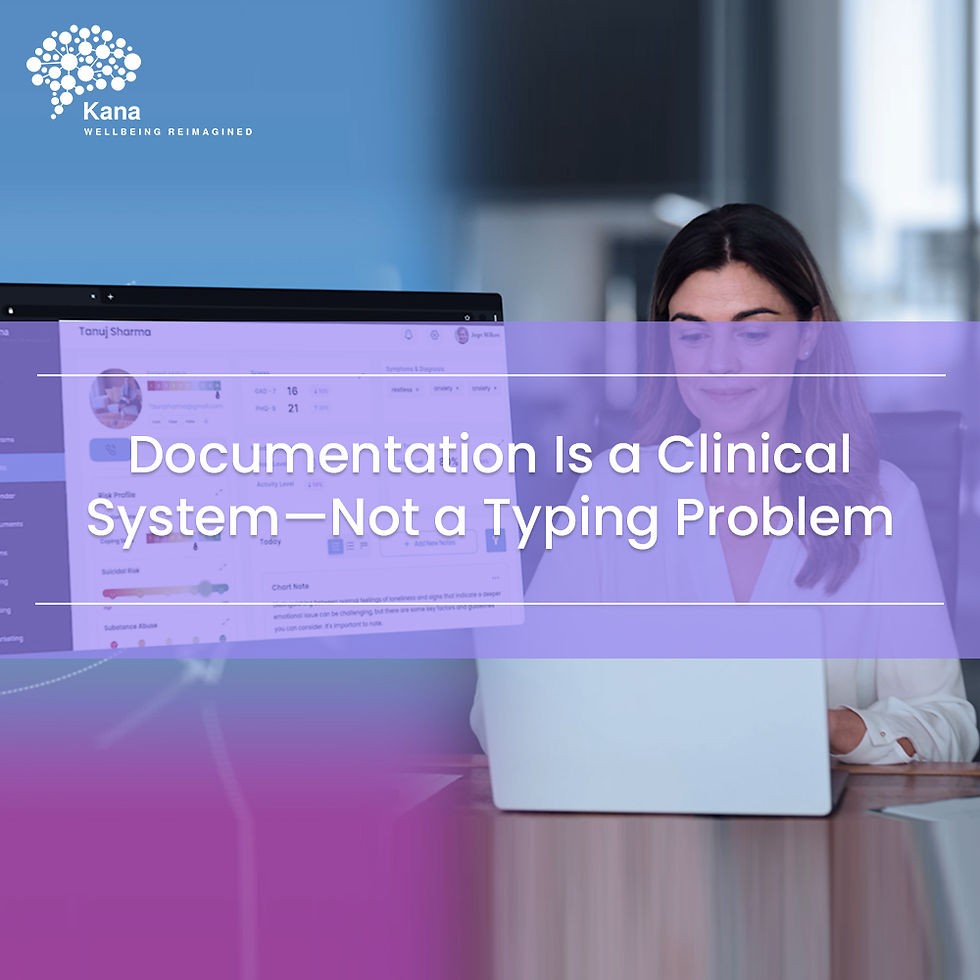
AI platforms that fail to understand this clinical context may speed up note-writing—but often at the expense of nuance, defensibility, and patient safety.
Enterprise behavioral health organizations need AI that functions as a clinical copilot, not a dictation assistant.
1. Native EHR Integration That Reduces Cognitive Load
AI documentation tools that live outside the EHR introduce friction instead of eliminating it.
Enterprise-ready behavioral health AI should:
Integrate directly with Epic, Cerner, Athena, Credible, NextGen, Valant, and similar systems
Map AI-generated content into existing note and treatment plan templates
Eliminate double documentation and manual copy-paste
Preserve existing clinical workflows
Kana is built to operate inside the EHR workflow, so documentation becomes a natural output of care—not an additional task.
2. Audit-Ready Transparency That Protects Clinicians and Organizations
In behavioral health, documentation quality is measured by defensibility—not just completeness.
AI-generated documentation must withstand:
Payer audits
Clinical quality reviews
Regulatory scrutiny
Legal review in high-risk cases
Enterprise leaders should require AI that:
Clearly distinguishes AI-generated content from clinician edits
Maintains full audit trails
Enforces payer-aligned and program-specific documentation standards
Flags high-risk content requiring clinician review
Kana’s clinical copilot approach prioritizes transparency, traceability, and audit safety- supporting clinician judgment rather than replacing it.
3. Standardization Without Sacrificing Clinical Judgment
As behavioral health organizations scale, documentation quality often becomes inconsistent across sites and programs.
Rigid templates create frustration and reduce clinical fidelity.Effective enterprise AI instead:
Establishes system-wide documentation standards
Adapts to state, payer, and program-specific requirements
Supports therapy, psychiatry, IOP, MAT, and care management
Preserves clinician autonomy within quality guardrails
Kana enables consistent, high-quality documentation across the enterprise—without turning clinicians into checkbox operators.
4. Risk Awareness and Longitudinal Clinical Context
Behavioral health risk rarely appears in a single session—it develops over time.
Enterprise AI platforms must support:
Detection of risk signals such as suicidality, disengagement, or escalation
Longitudinal clinical context across providers and care settings
Identification of gaps in clinical reasoning or documentation
Evidence-based phrasing that preserves therapeutic tone
Kana’s emotion-aware models surface clinically relevant signals to support proactive care and informed decision-making—without automating clinical judgment.
5. Real Time Savings—Without Accelerating Burnout
AI should reduce cognitive burden, not pressure clinicians to work faster.
Enterprise behavioral health AI should:
Reduce documentation time by 60–80%
Generate drafts from session audio, transcripts, or secure messages
Support progress notes, treatment plans, and interdisciplinary documentation
Lower administrative load across the care team
When documentation becomes lighter, clinicians don’t just work faster—they work better.
AI Documentation Is Becoming Core Clinical Infrastructure
Behavioral health organizations aren’t selecting a convenience tool. They’re choosing the foundation for how clinical work is documented, reviewed, and defended at scale.
The right AI documentation platform:
Strengthens clinical quality
Reduces organizational risk
Unifies multi-site operations
Protects clinician judgment
Improves patient outcomes
This is the difference between automation and clinical augmentation.
Built for Therapists. Designed for Behavioral Health Enterprises.
Kana was built alongside therapists, clinical leaders, and behavioral health operators who understand that documentation is inseparable from care.
If your organization is ready to reduce administrative burden without compromising clinical integrity or patient safety, it’s time to rethink what AI documentation should do.

See how behavioral health enterprises are reclaiming clinical time and strengthening documentation quality with Kana. Book a demo today: https://www.kanahealth.ai/


'Documentation Is a Clinical System - Not a Typing Problem', that's a good point! I'm thinking about how this applies to behavioral health enterprises, you know? If they split image into 6 parts and leverage AI, it's not just about speed, it's about quality and auditability. Just imagine reading all that on the subway, huh?